Moonstone Identification Guide: How to Tell Real from Fake
Moonstone, with its ethereal glow and celestial name, has captivated humanity for centuries. Ancient Romans believed it was formed from frozen moonlight, while in India, it is considered a sacred stone of the moon. However, as its popularity in bohemian and high-end jewelry grows, so does the prevalence of imitations.
Identifying a genuine moonstone requires a blend of scientific understanding and keen observation. Whether you are a jewelry collector or a mineral Enthusiast, this guide will provide you with the tools to confidently distinguish between natural moonstone, its varieties like rainbow moonstone, and common fakes like opalite.
What is Moonstone? The Science of Adularescence
True moonstone is a variety of the feldspar group mineral orthoclase. Its most famous characteristic is adularescence—a soft, billowy light that appears to float just beneath the surface of the stone.
This optical phenomenon is caused by the internal structure of the mineral. Moonstone is composed of alternating layers of orthoclase and albite. When light enters the stone, it scatters between these micro-layers, creating the "glow." In the gemological world, this is known as the Schiller effect.
The Appearance of Real Moonstone
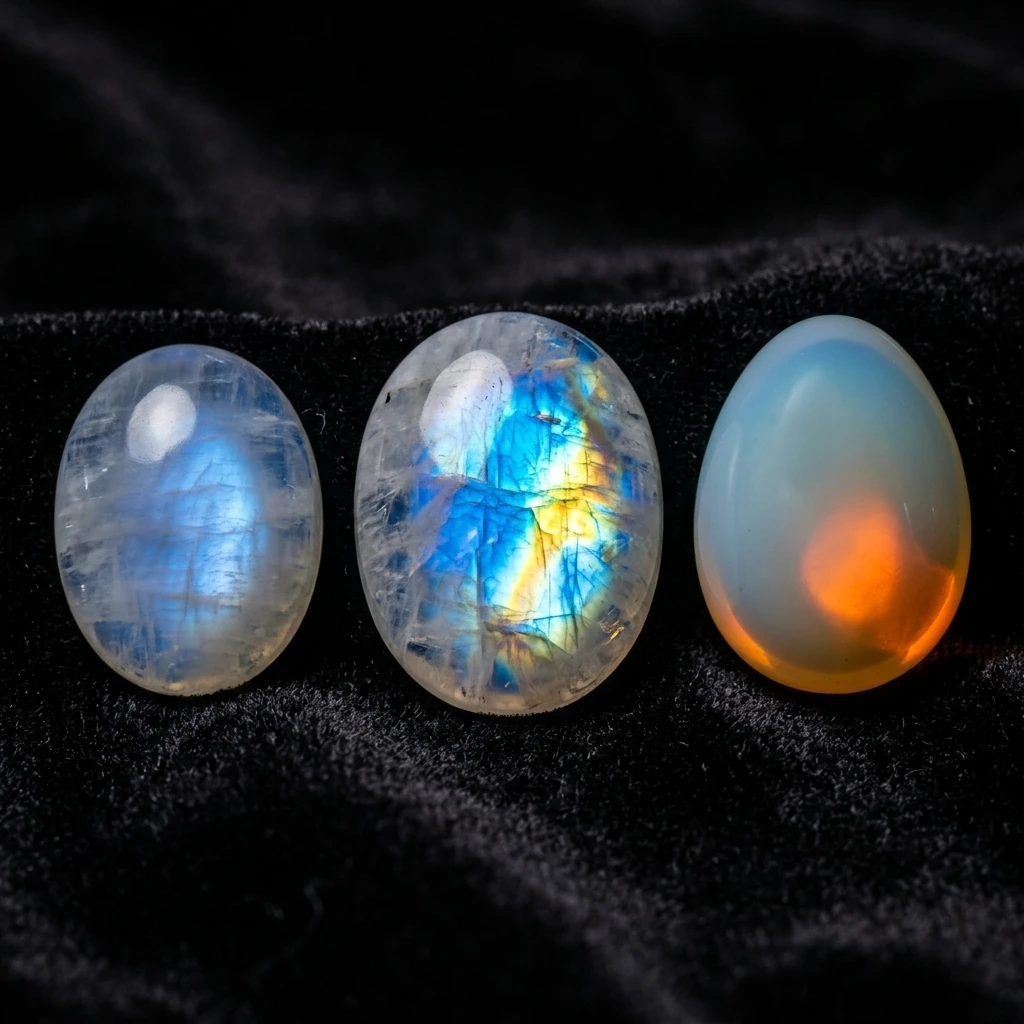
Natural moonstone typically has a milky or translucent body color. The glow (adularescence) is usually white or a soft, ghostly blue. While top-grade "Blue Moonstone" is highly sought after, most natural specimens will have a more subtle, internal sheen rather than a bright, surface-level flash.
The Comparison: Natural Moonstone vs. Variations and Fakes
Understanding the different "moonstones" on the market is the first step in identification. Not everything labeled "moonstone" is orthoclase, and some "moonstones" aren't even minerals.
1. Natural Moonstone (Adularia)
The classic moonstone. It is characterized by its white to blue adularescence. It often contains tiny, internal features called "centipedes"—small, horizontal stress cracks that look like the legs of a centipede under magnification.
2. Rainbow Moonstone (Labradorite)
While marketed as moonstone, Rainbow Moonstone is technically a variety of labradorite feldspar. Unlike the blue-only sheen of true moonstone, rainbow moonstone exhibits labradorescence, which includes a spectrum of colors: blue, yellow, orange, and sometimes purple.
Because it is a natural mineral of similar composition, rainbow moonstone is considered "real" in the jewelry trade, but it is a different species than orthoclase moonstone.
3. Opalite: The Most Common Fake
Opalite is a man-made glass that is frequently sold as "Opalite Moonstone" or simply "Moonstone." While beautiful, it has no mineral value.
- Opalite is perfectly clear or milky with a very uniform glow.
- Opalescence vs. Adularescence: Opalite glows orange or amber when held against a light source, a phenomenon called opalescence. Natural moonstone never does this.
5 Practical Tests to Identify Real Moonstone
If you have a piece of jewelry or a loose stone, use these tests to determine its authenticity.
1. The Moving Glow Test (Adularescence)
The most definitive sign of moonstone is how the light moves.
- Method: Place the stone under a single light source and tilt it slowly from side to side.
- Real: The glow should appear to "float" and move across the surface of the stone as the angle of light changes.
- Fake: In many glass imitations, the colors are static or simply change color based on the background, rather than shifting across the stone’s geometry.
2. The Loop/Loupe Test (Inclusions)
Natural stones are rarely "perfect."
- Method: Use a 10x jeweler’s loupe to look inside the stone.
- Real: Look for "centipedes" (fractures) or layers. If you see tiny internal flaws, it’s likely real.
- Fake: If the stone is 100% flawless and clear, be suspicious. If you see tiny round air bubbles, it is definitively glass (opalite). Natural minerals never contain perfectly spherical bubbles.
3. The Temperature Test
Feldspar is a poor conductor of heat compared to glass.
- Method: Hold the stone in your hand for a minute.
- Real: Genuine moonstone will feel quite cold to the touch and take time to warm up.
- Fake: Glass and plastic warm up almost immediately to your body temperature.
4. Background Color Shift
Opalite has a unique "tell" involving background colors.
- Opalite: It looks blue against a dark background but turns a distinct glowing orange/amber when held against the sky or a bright white light.
- Moonstone: Natural blue/white moonstone will retain its color regardless of the background light.
5. Hardness Test
Moonstone has a Mohs hardness of 6.0 to 6.5.
- Method: Try to scratch the stone with a high-quality steel knife (carefully!).
- Result: Steel (hardness 5.5) should not be able to easily scratch a real moonstone. If your "stone" is easily scratched by steel, it might be a softer glass or plastic.
Buying Guide: How to Avoid SCAMS
- Beware of "Opalite Moonstone": This name is a marketing trick. It is glass.
- Pricing: If a "high-quality" blue moonstone is suspiciously cheap (e.g., $5 for a 2-carat stone), it is likely a fake.
- Check the Source: Buy from reputable mineral dealers who distinguish between "Orthoclase Moonstone" and "Rainbow Moonstone (Labradorite)."
Identifying moonstone is about looking for the subtle imperfections of nature. While opalite and glass fakes may catch the eye with their perfection, they lack the historical soul and geological complexity of a true, earth-mined moonstone.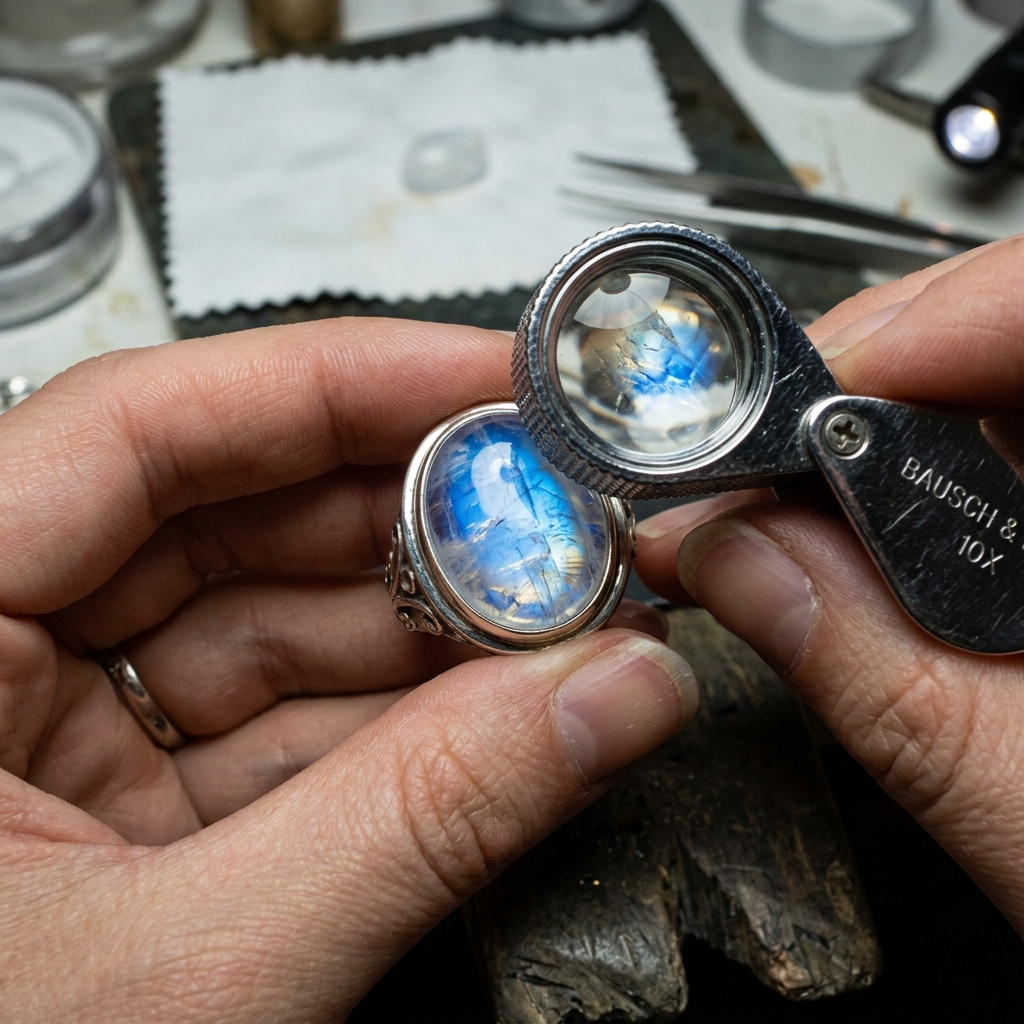
(See our detailed comparison chart below to see the physical differences between Natural Moonstone, Rainbow Moonstone, and Opalite.)
Available in other languages
- enMoonstone Identification Guide: How to Tell Real from Fake
- ru Как отличить настоящий лунный камень от подделки: полное руководство
- es Moonstone Identification Guide: How to Tell Real from Fake
- fr Moonstone Identification Guide: How to Tell Real from Fake
- de Mondstein-Identifikationsleitfaden: Echten von Falschem unterscheiden
- it Guida all'Identificazione della Pietra di Luna: Come Distinguere il Vero dal Falso
- pt Guia de Identificação da Pedra da Lua: Como Diferenciar a Real da Falsa
- pl Przewodnik po Identyfikacji Kamienia Księżycowego: Jak Rozpoznać Prawdziwy Kamień
- uk Посібник з ідентифікації місячного каменю: як відрізнити справжній від підробки
- tr Ay Taşı Tanımlama Rehberi: Gerçek ve Sahte Nasıl Ayırt Edilir?
- sv Moonstone Identification Guide: How to Tell Real from Fake
- no Moonstone Identification Guide: How to Tell Real from Fake
- hi मूनस्टोन पहचान गाइड: असली और नकली में अंतर कैसे करें
- id Moonstone Identification Guide: How to Tell Real from Fake
Frequently Asked Questions
What is the single most reliable visual sign of a real moonstone?
Real moonstone shows adularescence — a soft, floating blue/white sheen that seems to move across the stone as you rotate it in the light. That sheen is produced by layered feldspar structures inside the gem, not a surface reflection; if the 'glow' stays fixed or looks like paint on the surface, it's likely a fake or coated piece.
What should I look for with a 10× loupe to tell natural moonstone from glass or plastic?
Under 10× magnification natural moonstone commonly shows thin, parallel plate-like inclusions and cleavage planes (lamellar structure). Fakes (glass) often show rounded gas bubbles and curved flow lines; plastic may show molding lines or a grainy surface. Also look for a lack of curved striations — curved lines are a giveaway for glass.
How can I check for assembled pieces (doublets/triplets) or coatings without damaging the stone?
Hold the stone to the light and view it from the side. Doublets/triplets often show a visible seam or distinct layers and sometimes a flat backing. Coatings may flake or have an edge where the coating stops. Use a bright directional light and rotate the stone — a discontinuous change in adularescence or a visible glue line is a sign of assembly.
Are there safe home tests that help distinguish real moonstone from imitations?
Yes — non‑destructive checks: feel the temperature (natural stone feels cool longer than plastic), observe the adularescence by rotating under a single light source, and weigh the stone (plastic is noticeably lighter). Avoid hot‑needle, acid, or scratch tests on finished jewelry. For anything valuable, get professional testing rather than risky home methods.
When should I ask for a gem lab report or expert opinion?
If the stone is expensive, unusually perfect, or you suspect treatment/assembly, request a report from a recognized lab (GIA, AGL, etc.) or buy from a reputable dealer with a return policy. Labs can confirm natural vs. synthetic, identify treatments, and verify the feldspar type and optical properties.