Moldavite Verification Guide: How to Spot a Real Gem from a Glass Fake
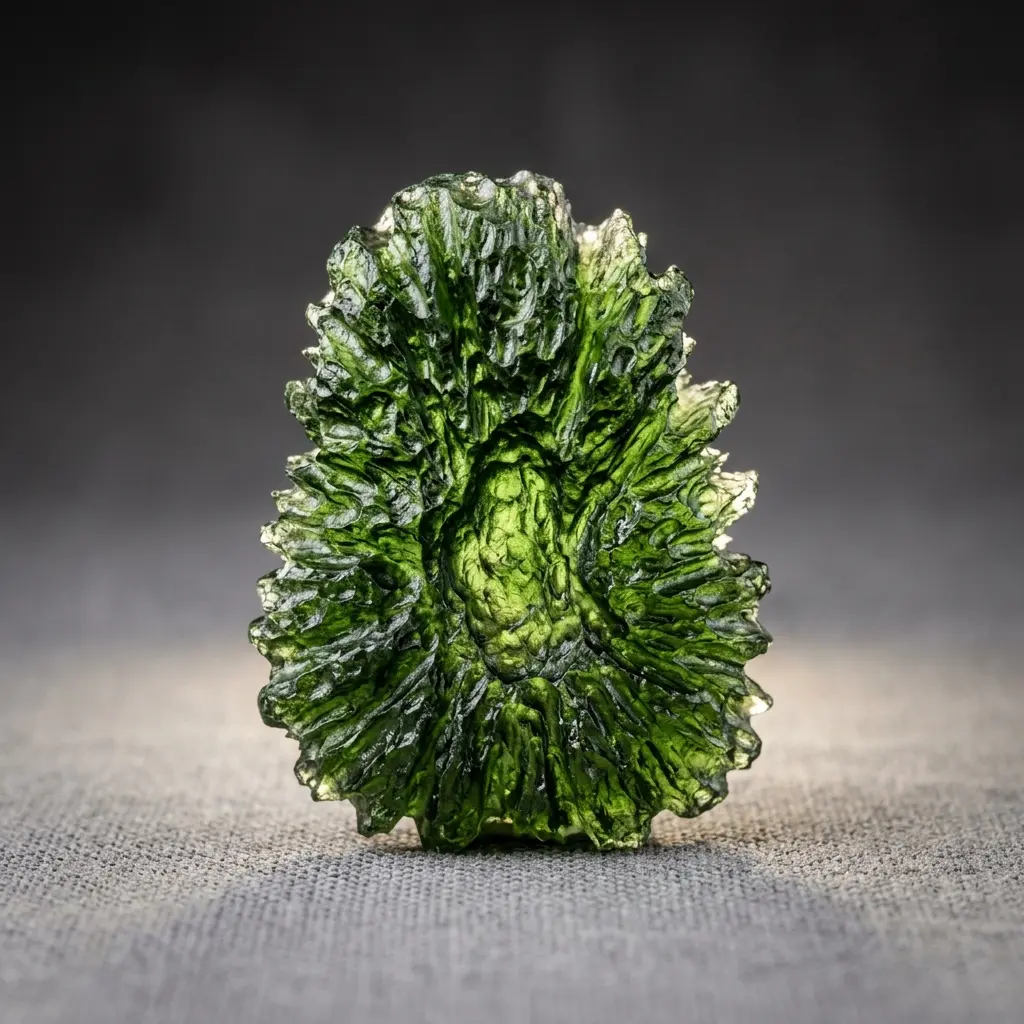
Moldavite is not just a gemstone; it is a cosmic relic. Formed approximately 14.7 million years ago during a massive meteorite impact in the Ries Crater (modern-day Germany), this tektite was blasted into the atmosphere and fell as a rain of molten green glass over the Bohemian plateau of the Czech Republic.
Because of its limited quantity, unique green hue, and high-vibrational reputation in the metaphysical community, Moldavite has become one of the most faked gemstones on the planet. Today, the market is flooded with "bottle green" glass imitations originating from factories in Asia.
In this guide, we will break down the exact physical and microscopic markers you need to look for to verify your Moldavite.
The "Green Bottle Glass" Problem
High-quality fakes are no longer just melted green bottles. Modern counterfeiters use sophisticated molds and acid-etching to mimic the rough, pitted surface of natural Moldavite. Some even incorporate artificial bubbles to confuse the untrained eye. However, science—specifically the physics of tektite formation—provides us with several "smoking guns" that fakes simply cannot replicate.
1. The Microscopic Signature: Lechatelierite
If you have a faceted or cut piece of Moldavite, or if you can see into a translucent raw specimen with a 10x or 40x loupe, look for Lechatelierite.
Lechatelierite is high-temperature, pure silica glass ($SiO_2$). It forms only under extreme heat and pressure—conditions present during a meteorite impact.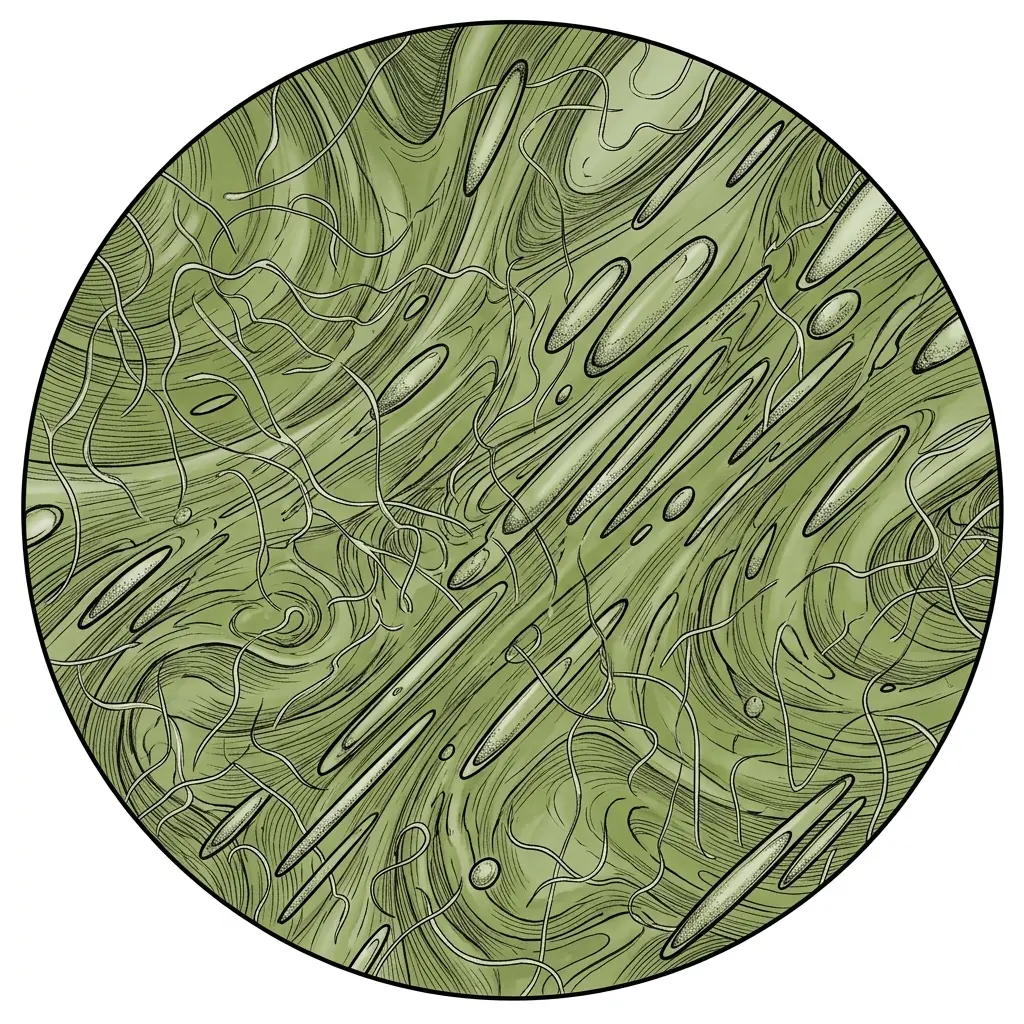
What to look for:
- Wire-like Threads: Lechatelierite appears as tiny, wavy, wire-like threads or "hairs" frozen within the green matrix.
- Worm-like Inclusions: They look like silver or transparent worms swirling through the stone.
- Why it's the "Smoking Gun": Fakes are made in industrial kilns that never reach the instantaneous, chaotic temperatures of a meteorite impact. Replicating these delicate, high-silica threads is virtually impossible in mass-produced glass.
2. Reading the Bubbles: Shape and Physics
Almost all Moldavite contains bubbles, but their geometry tells a story of atmospheric flight.
Real Moldavite Bubbles:
- Highly Irregular: Bubbles in real Moldavite are often stretched, flattened, or "torpedo-shaped" due to the intense centrifugal forces and atmospheric drag the molten glass experienced as it fell back to Earth.
- Random Distribution: They are scattered randomly throughout the stone, not concentrated in one area.
- Flow Lines (Schlieren): Look for "Schlieren"—swirling flow lines that look like syrup being stirred in water. These lines often wrap around the bubbles.
Fake Glass Bubbles:
- Perfectly Spherical: Fakes often have perfectly round, uniform bubbles. This is a sign of static cooling in a kiln.
- Surface Bubbles: In fakes, bubbles are often trapped just beneath the surface or clustered in a way that suggests they were poured into a mold.
3. Surface Sculpturing (The "Skin")
The unique texture of Moldavite is the result of millions of years of natural etching by acidic groundwater.
The "Besednice" vs. Regular Pit Texture:
- Natural Variability: No two pieces of real Moldavite are identical. The sculpturing should be sharp, intricate, and somewhat chaotic.
- The "Hedgehog" Look: Besednice-type Moldavites have extremely deep, spine-like etchings.
- Acid-Etched Fakes: Counterfeiters often take molded glass and dip it in hydrofluoric acid to create a rough texture. However, these fakes often look "soft" or "soapy" at the edges. If you see two pieces of Moldavite that have the same shape or the same pattern of pits, they are definitely fakes from the same mold.
4. Color and Transparency
The "Olive Green" Spectrum:
- Natural Colors: Authentic Moldavite ranges from deep forest green and moss green to brownish-green or olive.
- The Fake "Neon": Many fakes are a bright, "neon" green or a vibrant, transparent emerald color. If it looks like a piece of a Heineken bottle, it probably is.
- Luster: Real Moldavite has a "cold" skin. When unpolished, it should be matte with a slight oily sheen, never perfectly glossy like a marble.
5. Origin and Market Red Flags
- Source: 99.9% of Moldavite comes from the Czech Republic. If a seller says it's from "China," "Thailand," or "India," it is a fake tektite or common obsidian.
- The "Certification" Scam: Be wary of sellers providing "Certificates of Authenticity" from unknown labs. A genuine appraisal from a reputable gemological institute (like GIA) is valuable, but a printed card from a eBay seller means nothing.
Use the Interactive Checklist Below
Before you make a purchase, use our checklist to evaluate the specimen in hand. Note that raw Moldavite is harder to check for Lechatelierite than faceted stones, but surface sculpturing and weight are still strong indicators.
Available in other languages
- enMoldavite Verification Guide: How to Spot a Real Gem from a Glass Fake
- ru Как отличить настоящий молдавит от подделки: полное руководство
- es Guía de verificación de la Moldavita: Cómo distinguir una gema real
- fr Guide de vérification de la Moldavite : Distinguer le vrai du faux
- de Moldavit-Verifizierungsleitfaden: Echte Steine vs. Glasfälschungen
- it Guida alla verifica della Moldavite: Riconoscere l'originale
- pt Guia de Verificação da Moldavita: Como Identificar a Gema Real
- pl Przewodnik po weryfikacji mołdawitu: Jak rozpoznać prawdziwy kamień
- uk Як відрізнити справжній молдавіт від підробки: повний посібник із перевірки
- tr Moldavit Doğrulama Kılavuzu: Gerçek taşı cam sahtesinden ayırt etme
- sv Moldavit verifieringsguide: Hur man skiljer en äkta ädelsten från en glasförfalskning
- no Moldavitt verifiseringsguide: Slik skiller du en ekte edelsten fra glassforfalskninger
- hi मोल्डावाइट सत्यापन गाइड: असली रत्न को कांच की नकल से कैसे पहचानें
- id Panduan Verifikasi Moldavite: Cara Membedakan Batu Permata Asli dari Kaca Palsu
Frequently Asked Questions
What are the most obvious visual signs that a piece is real moldavite?
Real moldavite typically has an olive to bottle-green color (sometimes brownish), a pitted/etched or sculpted surface with flow lines, and irregular internal features like elongated bubbles and streaky inclusions. Perfectly smooth, uniformly colored, or glassy-looking pieces with many round bubbles are likely fakes.
Can I tell authenticity by weight, hardness, or touch?
You can get clues but not definitive proof: moldavite is fairly lightweight for its size and has a glassy hardness around 5.5–6.5. It may feel slightly less dense than common glass, but differences are small and unreliable without precise tools.
How useful is magnification or UV light in spotting fakes?
Under 10–30x magnification look for natural flow lines, elongated or asymmetric vesicles, and brownish weathering zones. Many fakes show perfectly round air bubbles or swirl marks. Moldavite generally shows no strong UV fluorescence; if a specimen fluoresces, consider it suspicious.
Should I trust cheap online listings or do any non-destructive tests at home help?
Be cautious with very low prices or sellers with no provenance. Non-destructive home checks: examine surfaces and internal patterns with a loupe, compare color to known examples, and ask the seller for origin (Bohemian/Moravian, Czech Republic). Avoid destructive tests (hot-needle, acids) which ruin specimens and may be illegal to claim as natural when altered.
What are reliable ways to confirm authenticity if I’m still unsure?
Buy from reputable dealers who provide provenance or lab certificates, or have the piece tested by a gemological lab (refractive index, specific gravity, FTIR/spectroscopy). Labs can distinguish natural tektite from manmade glass reliably; this is the best route for high-value pieces.