Jade Identification Guide: Real vs. Fake (Jadeite & Nephrite)
Jade is one of the most enigmatic and misunderstood minerals in the world. Often associated with ancient traditions, luck, and prosperity, the market for jade is vast—and so is the market for imitators. Knowing how to distinguish genuine jade from common simulants like serpentine, aventurine, and glass is essential for any collector or buyer.
In this guide, we will break down the differences between the two "real" jades, explain the industry grading system (A, B, and C Jade), and provide an interactive comparison tool to help you identify what you have.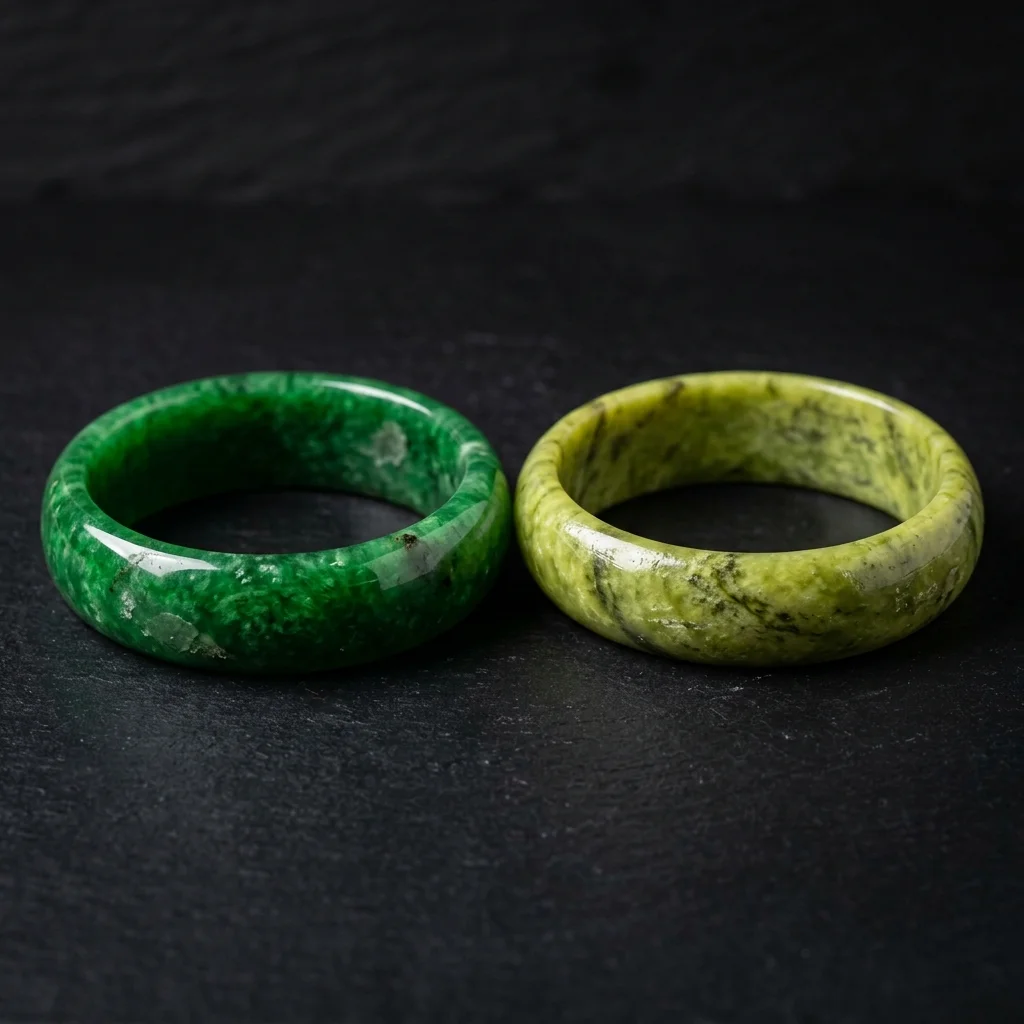
The Two Faces of Genuine Jade
When people talk about "real jade," they are actually referring to two distinct minerals: Jadeite and Nephrite. While they look similar on the surface, they have very different chemical compositions and physical properties.
1. Jadeite (The Emperor of Jade)
Jadeite is the rarer and more expensive form of jade. Most high-end jewelry, especially pieces from Myanmar (Burma), is jadeite.
- Color Range: Vibrant greens (Imperial Jade), lavender, red, yellow, and blue.
- Hardness: 6.5 to 7.0 (harder than glass).
- Structure: Granular or felted texture under magnification.
2. Nephrite (The Traditional Stone)
Nephrite is the "traditional" jade used in most ancient Chinese carvings. It is tougher and more resistant to chipping than jadeite, although slightly softer.
- Color Range: Creamy whites (Mutton Fat), olive greens, dark forest greens, and black.
- Hardness: 6.0 to 6.5.
- Structure: Tightly interlocking fibers (like a woven carpet), making it incredibly tough.
The A-B-C Grading System (Treatments)
Even if a stone is chemically "jadeite," it may have been treated to improve its appearance. In the trade, these are classified into three grades:
- Grade A Jade: All-natural and untreated. The stone has only been cut and polished, often finished with a traditional surface coating of natural beeswax to enhance its luster. No artificial treatments are used. This is the only type considered an investment grade.
- Grade B Jade: Bleached and Polymer Impregnated. The stone is soaked in acid to remove "dirty" spots and then filled with polymer. Over time, the polymer turns yellow or brittle.
- Grade C Jade: Dyed and Bleached. Similar to Grade B, but with Artificial colors added to the polymer. This jade has zero resale value and the color can fade.
Common "Fake Jades" and Simulants
If your "jade" isn't Jadeite or Nephrite, it's likely one of these common simulants:
- Serpentine (New Jade): This is the most common substitute. It is much softer than real jade and can be scratched by a steel needle.
- Aventurine Quartz (Indian Jade): A type of quartz with small mica inclusions that give it a "shimmer." Look for granular structures that don't match the waxy look of jade.
- Glass (Translucent Jade): Often used for bangles. Look for air bubbles under a loupe—real jade never has air bubbles.
- Plastic/Resin: These feel light and "warm" to the touch, whereas real jade stays cold for a long time.
At-Home Identification Tests
While only a laboratory can give you 100% certainty, these three tests can help you weed out 90% of fakes at home.
1. The Sound Test (The "Clink")
If you have two jade pieces, gently tap them together.
- Real Jade: Produces a high-pitched, clear, ringing sound (like a bell).
- Fake Jade (Grade B/C or Glass): Produces a dull, "plastic-like" thud.
2. The Temperature Test
Jade has high thermal mass, meaning it retains its temperature well.
Real Jade: Feels icy cold to the touch and takes much longer to warm up in your hand than glass or resin.

Fake Jade (Glass/Plastic): Warms up quickly or feels room-temperature from the start.

Note: While this test is excellent for weeding out synthetic materials, keep in mind that other natural stone simulants, like Aventurine quartz, will also feel cold. Therefore, this test should be used in combination with others.
3. The Needle Scratch Test (Use Extreme Caution!)
Be very careful, as this will permanently damage the stone if it is a softer simulant. Always test on an inconspicuous area (like the inside of a bangle).
- Real Jade: Has a Mohs hardness of 6.0 to 7.0. A standard steel needle (hardness ~5.5) will not scratch it. However, beware that some modern hardened steel tools can reach a hardness of 6.5, which might leave a faint mark on Nephrite.
- Fake Jade (Serpentine/Soapstone): Will be easily and deeply scratched by standard steel.
Frequently Asked Questions
Is "New Jade" real jade?
No. "New Jade" is a trade name for Serpentine. While it is a beautiful natural stone, it is not mineralogically jade and has a much lower value.
Can a jade roller be fake?
Yes, many inexpensive jade rollers sold online are actually made of marble or aventurine quartz that has been dyed green. Real jade rollers are much heavier and stay cold against the skin.
What is "Mutton Fat" jade?
This is a highly prized type of Nephrite jade that is creamy white and translucent, resembling pieces of fat. It is historically very significant in Chinese culture.
Available in other languages
- enJade Identification Guide: Real vs. Fake (Jadeite & Nephrite)
- ru Как отличить настоящий жад от подделки: гид по жадеиту и нефриту
- es Guía de identificación de jade: real vs. falso (jadeíta y nefrita)
- fr Guide d'identification du jade : vrai ou faux (jadéite et néphrite)
- de Jade-Identifikationsratgeber: Echt vs. Gefälscht (Jadeit & Nephrit)
- it Guida all'identificazione della giada: vera vs. falsa (giadeite e nefrite)
- pt Guia de Identificação de Jade: Verdadeira vs. Falsa (Jadeíta e Nefrite)
- pl Przewodnik po identyfikacji jadeitu: prawdziwy vs. fałszywy (jadeit i nefryt)
- uk Довідник з ідентифікації жаду: справжній чи підробка (жадеїт і нефрит)
- tr Yeşim Tanımlama Rehberi: Gerçek vs. Sahte (Jadeit ve Nefrit)
- sv Jade-identifikationsguide: Äkta vs. Falsk (Jadeit & Nefrit)
- no Jade-identifikasjonsguide: Ægte vs. Falsk (Jadeit & Nefrit)
- hi जेड पहचान मार्गदर्शिका: असली बनाम नकली (जेडाइट और नेफराइट)
- id Panduan Identifikasi Giok: Asli vs Palsu (Jadeit & Nefrit)
Frequently Asked Questions
Is 'New Jade' real jade?
No. 'New Jade' is a trade name for Serpentine. While it is a beautiful natural stone, it is not mineralogically jade and has a much lower value.
Can a jade roller be fake?
Yes, many inexpensive jade rollers sold online are actually made of marble or aventurine quartz that has been dyed green. Real jade rollers are much heavier and stay cold against the skin.
What is 'Mutton Fat' jade?
This is a highly prized type of Nephrite jade that is creamy white and translucent, resembling pieces of fat. It is historically very significant in Chinese culture.
How can I tell if jadeite is Grade A?
Grade A jadeite is all-natural and untreated. Determining this often requires professional laboratory testing (spectroscopy) to detect polymers or dyes used in Grade B and C jade.